


Cabins, city limits and uncertain ground: Iqaluit’s new rules explained
After years of informal construction and a prolonged building freeze, Iqaluit’s cabin-licensing system offers a route to approval. But owning a cabin is not the same as holding the right to keep it on the land — an important distinction for residents and prospective buyers.
 View full image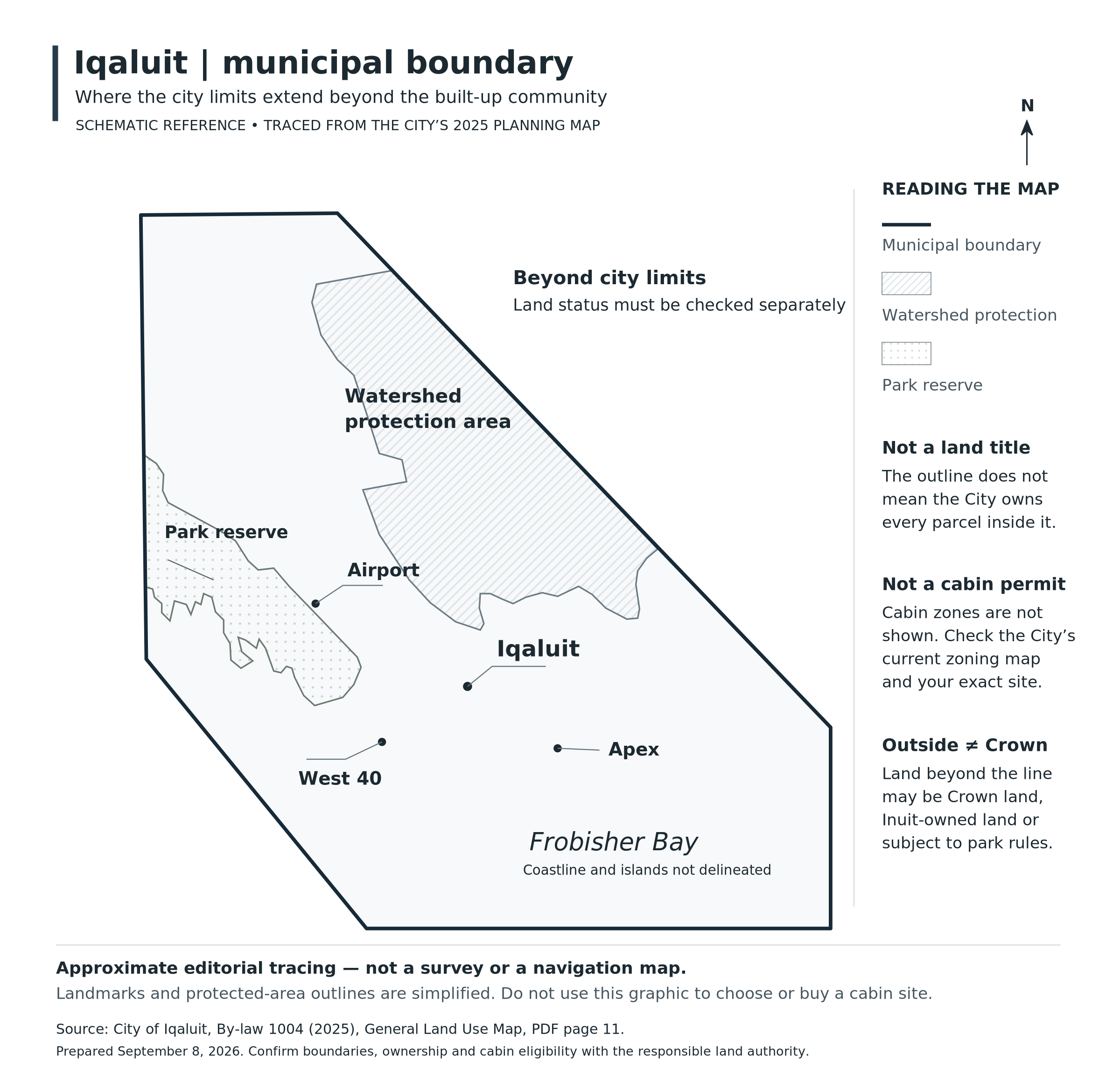
IQALUIT — Iqaluit’s cabin-licensing program, which opened to applications on September 25, 2025, offers a route to approval for new cabins and qualifying existing structures within designated areas. But it also brings an important distinction into sharper focus: ownership of a cabin and permission to occupy its location are not the same thing.
A cabin can mean very different things to different people: a base for harvesting, somewhere to take the children fishing, a place to spend time with family, or simply a quiet escape from town. In community knowledge documented by the Qikiqtani Inuit Association, camping and travelling on the land are closely connected to harvesting, maintaining social connections and passing knowledge between generations.
For Iqaluit’s municipal government, cabins also raise practical questions: who is occupying a site, whether other residents can still reach fishing grounds, and what happens when a structure conflicts with environmental protection or future development. Those concerns are reflected in the City’s amended planning rules.
Cabins within the Municipal Boundary · TRAVEL, TRAILS, AND HABITATION · By-law #1004 — Amendment to General Plan By-law #898 · By-law #1006 — Amendment to Land Administration By-law #897
A dispute years in the making
The current rules did not arrive out of nowhere.
In July 2020, Iqaluit council temporarily suspended construction of new cabins on city land while it worked on a regulatory framework. By October, a proposed research and consultation process aimed to have rules ready for summer 2021. Even then, council recognized that delays had consequences: residents typically moved building materials over the snow before the summer construction season.
That timetable slipped. In September 2022, the City was still advising residents that cabin construction on municipal lands was unauthorized until regulations and an approval process were finalized. It directed people interested in building to explore separately authorized opportunities on federal or Inuit-owned land.
Iqaluit city councillors look to create new rules for cabins on municipal land · Update on Cabin Construction
By July 2024, frustration was being expressed openly at council. Nunatsiaq News reported that cabins continued to appear around West 40 and the road toward the new landfill despite the moratorium. City spokesperson Geoff Byrne attributed the policy delays to planning-department turnover, changes in council and resources being diverted to emergencies. Councillors also raised concerns about public enjoyment of the Sylvia Grinnell River and other outdoor areas.
That history matters. The dispute was not simply between a previously permissive city and residents suddenly unwilling to follow rules. It also involved a prolonged period in which the City had prohibited new construction without completing the replacement approval system it had proposed.
Iqaluit cabin policy still in works, 4 years on · Iqaluit city councillors look to create new rules for cabins on municipal land · Update on Cabin Construction
When the proposed framework reached the planning committee in January 2025, Coun. Romeyn Stevenson acknowledged the municipality’s own role.
“This is a responsibility that the city has ignored for a long time,” he said, according to Nunatsiaq News.
Council approved the three related bylaw amendments on July 8, 2025, followed by the September application launch. The changes address land-use planning, zoning and administration of cabin licences.
Iqaluit proposes licensing, zoning for cabins on city lands · Iqaluit council approves bylaws for cabin zones, licensing · Cabins within the Municipal Boundary
Why the City wants a system
The new approach is not a blanket prohibition on cabins. The amended General Plan recognizes their importance for country-food harvesting, healing, family use and recreation. It also directs cabin development away from watersheds, sensitive environments and areas needed for future growth or other uses.
There is a difference between enjoying a place and effectively claiming it for private use. A cabin close to a fishing spot or established trail may be convenient for its owner while making the same location harder for others to use. The City’s application guide identifies interference with public fishing, hunting or gathering access as a reason an existing cabin’s application may be denied.
An approval system can make those competing interests more visible. The General Plan calls for a public, geographically mapped cabin registry, showing licensed locations, available areas and community trails.
Whether that system becomes a workable compromise will depend on more than the wording of the bylaws. Clear explanations, consistent decisions and a fair approach to longstanding cabins will matter just as much.
By-law #1004 — Amendment to General Plan By-law #898 · Cabin Licensing
What the licensing rules require
The City’s application guide sets out the basic terms: five-year licences, one per Iqaluit resident aged 19 or older, with proof of residency. The first five-year term has no licence fee. A one-year renewal grace period and a City-issued identification sign are also provided. The guide does not promise that all future terms will remain free.
Location remains central. New cabins must be in designated Cabin Zones, marked C in the zoning bylaw. Legacy Cabin Zones, marked C(1), accommodate qualifying existing cabins rather than opening those areas to unrestricted new construction.
For new cabins, the zoning rules generally require separation of 250 metres between cabins, 30.5 metres from lakes, watercourses and designated trails, and 15.25 metres from community trails.
A cabin licence is not the only approval to consider: the amended General Plan also requires a development permit for cabins in the designated zones.
Cabin Licensing · By-law #1005 — Amendment to Zoning By-law #899 · By-law #1004 — Amendment to General Plan By-law #898
For existing owners, an important date is March 25, 2025. Cabins constructed before that date may qualify for legacy treatment, including relief from normal separation requirements. But age alone is insufficient: the site must be in an eligible zone, and applicants must establish the cabin’s history and their status as its primary holder. Derelict and abandoned cabins may be refused.
In other words, “it has always been there” is relevant evidence — not automatic approval.
Cabin Licensing · By-law #1005 — Amendment to Zoning By-law #899
The fine print: permission, not permanent tenure
A municipal cabin licence is not a land title. By-law 1006 calls it a “personal and revocable privilege” and says it creates no title, interest or estate in the land.
Its standard terms allow cancellation on 180 days’ written notice for City-development reasons, including infrastructure, resource extraction and conservation. Expiry or cancellation can leave the holder responsible for removing structures and restoring the site. Permanent habitation requires express written municipal permission, and residency must be demonstrated at application or renewal.
Five years is therefore the normal licence term — not an unconditional promise that a cabin can remain for five years.
Nor should owners assume a licensed cabin comes with normal residential services. The zoning bylaw defines cabins as unserviced: municipal roads, water and sewer services, fire protection and power connections are not part of that designation.
These limitations do not make a cabin unsuitable for its intended purpose. They do make it important to distinguish an on-the-land cabin from an ordinary residential property.
By-law #1006 — Amendment to Land Administration By-law #897 · By-law #1005 — Amendment to Zoning By-law #899
When a cabin carries a six-figure asking price
The distinction becomes particularly important when money changes hands.
Consider a hypothetical cabin advertised online for $150,000. This is an illustration, not a verified listing or sale. Its materials, equipment, construction and location may all be attractive. But the asking price itself says nothing about the buyer’s ability to remain on the site.
A careful buyer has two separate questions to answer: what physical property am I buying, and what permission will I have to keep it there?
The City’s guide says new-cabin licences may be transferred only after three years in good standing. The bylaw’s transfer clause refers more broadly to cabin licences. Buyers of any existing cabin should obtain written confirmation of the transfer rules applicable to that particular licence and transaction.
Cabin Licensing · By-law #1006 — Amendment to Land Administration By-law #897
For a substantial purchase, sensible due diligence would include checking the exact coordinates and land authority, examining the actual licence or lease, and confirming the buyer’s eligibility and the proposed transfer before paying a non-refundable deposit. A Nunavut lawyer should review the transaction where the amount or uncertainty warrants it.
Photos, receipts for building materials and a seller’s account of longstanding use can help establish what exists. They are not substitutes for confirmation from the authority responsible for the land.
There is also a practical valuation question: what would the cabin be worth to the buyer if it had to be moved? That question does not imply that removal is imminent. It asks the buyer to consider a risk that photographs of a finished cabin will not reveal.
A cabin may still offer considerable personal and recreational value. The danger is paying for the security of an ordinary property transaction when that security has not been established.
By-law #1006 — Amendment to Land Administration By-law #897
Beyond city limits is not beyond the rules
Moving farther from town changes the jurisdictional question. It does not eliminate it.
The first step is to establish whether a site is on federal Crown land, Inuit-owned land, or land subject to a park or other special regime. The City has itself directed cabin applicants to different authorities for these categories.
For ordinary recreational use on federal Crown land, residents should seek the appropriate land authorization through Crown-Indigenous Relations and Northern Affairs Canada. Its land-administration office issues surface leases and licences of occupation. Federal guidance also states that acquiring Crown land through homesteading — occupying and developing it before obtaining an interest — is not available in Nunavut.
Consequently, a remote location and a history of unchallenged use should not be treated as substitutes for checking the site’s legal status. Whether a lease or another authorization can be obtained, renewed or transferred depends on the actual land and applicable terms.
Update on Cabin Construction · Land Administration Office
Inuit-owned land has a different administrator. The Qikiqtani Inuit Association publishes a recreational cabin lease application that asks for the cabin’s purpose, coordinates, land parcel, intended use and waste-disposal arrangements. That is another indication that “outside the city” does not mean an absence of land-management requirements.
Administration of Crown land is also approaching a significant transition. Under Nunavut’s devolution arrangements, the territorial government is scheduled to assume administration and control of Crown lands, natural resources and inland waters on April 1, 2027. That transition should not be mistaken for automatic approval of an individual cabin.
Application for Recreational Lease on Inuit Owned Lands · Government of Canada, Government of Nunavut and Nunavut Tunngavik Incorporated Finalize a Decision on the 2023 Recommended Nunavut Land Use Plan
Inuit outpost camps are not simply recreational cottages
Any account of cabin regulation in Nunavut must also distinguish ordinary recreational use from rights protected by the Nunavut Agreement.
Article 7 recognizes outpost camps occupied by Inuit families or groups for wildlife harvesting and associated use of the land. It provides for continued occupation and establishment of qualifying camps, subject to the Agreement. New camps generally require approval from the appropriate hunters and trappers organization; within municipal boundaries, municipal approval is also required and must not be unreasonably withheld.
The Agreement also contains obligations to make suitable land available and protects qualifying harvesting-related occupation from fees, rent and similar charges. Parks and conservation areas have additional provisions.
Those protections mean an Inuit harvesting camp should not automatically be treated as legally identical to an ordinary recreational cabin. Equally, buyers should not assume that a seller’s Inuit harvesting rights become theirs through a private sale.
Where those rights are relevant, the appropriate Inuit organization and hunters and trappers organization should be involved — not just the buyer, seller and municipal office.
A clearer system, with difficult decisions still ahead
The licensing program gives Iqaluit something it lacked during the long moratorium: a defined route through which residents can seek approval for new cabins and resolve the status of qualifying existing ones.
Its potential benefit is clarity. Owners should be better able to understand their obligations; prospective buyers should have documents to examine; and the public should have a way to identify and raise concerns about proposed locations.
The difficult task is ensuring that administration does not erase the reasons people want cabins in the first place. Access to the land is not simply a question of leisure-property development. For Inuit, it can involve harvesting, family relationships, cultural continuity and treaty-protected rights.
A successful system would protect those interests while preserving public access and preventing avoidable conflicts.
For anyone considering a purchase, the central lesson is straightforward: understand the right to occupy the site before deciding what the cabin is worth.
Cabins within the Municipal Boundary · TRAVEL, TRAILS, AND HABITATION · ARTICLE 7 — OUTPOST CAMPS
Where to learn more
Residents seeking municipal cabin information can contact the City’s Planning and Development department at planning@iqaluit.ca or 867-979-5661. The City’s cabin-licensing information page provides access to the application process and related policies.
This article explains the published framework. It is not a determination of any particular cabin’s status or a substitute for site-specific legal advice.
Cabins within the Municipal Boundary · Cabin Licensing
Reference map: Iqaluit’s municipal boundary
The accompanying illustration is a simplified editorial tracing of the City’s 2025 General Land Use Map, with approximate landmarks. It is not a surveyed parcel map or a cabin-eligibility map. The official source map appears on PDF page 11 of By-law 1004.
Importantly, the municipal boundary does not establish that the City owns every parcel inside it. The land-administration bylaw distinguishes municipal land from other land over which the City may have administrative authority. An individual site requires a separate ownership and authorization check.
The graphic does not show approved cabin sites or the detailed cabin zones. Use the City’s current zoning information and confirmation from the responsible land authority before selecting, building on or buying a cabin site.
By-law #1004 — Amendment to General Plan By-law #898 · By-law #1006 — Amendment to Land Administration By-law #897 · By-law #1005 — Amendment to Zoning By-law #899
Comments
0 approved comments. Every comment is reviewed before appearing.
Comments appear here after identity verification and News Desk review.